About Taiwan
Geography, history and a bit of language.
Geography
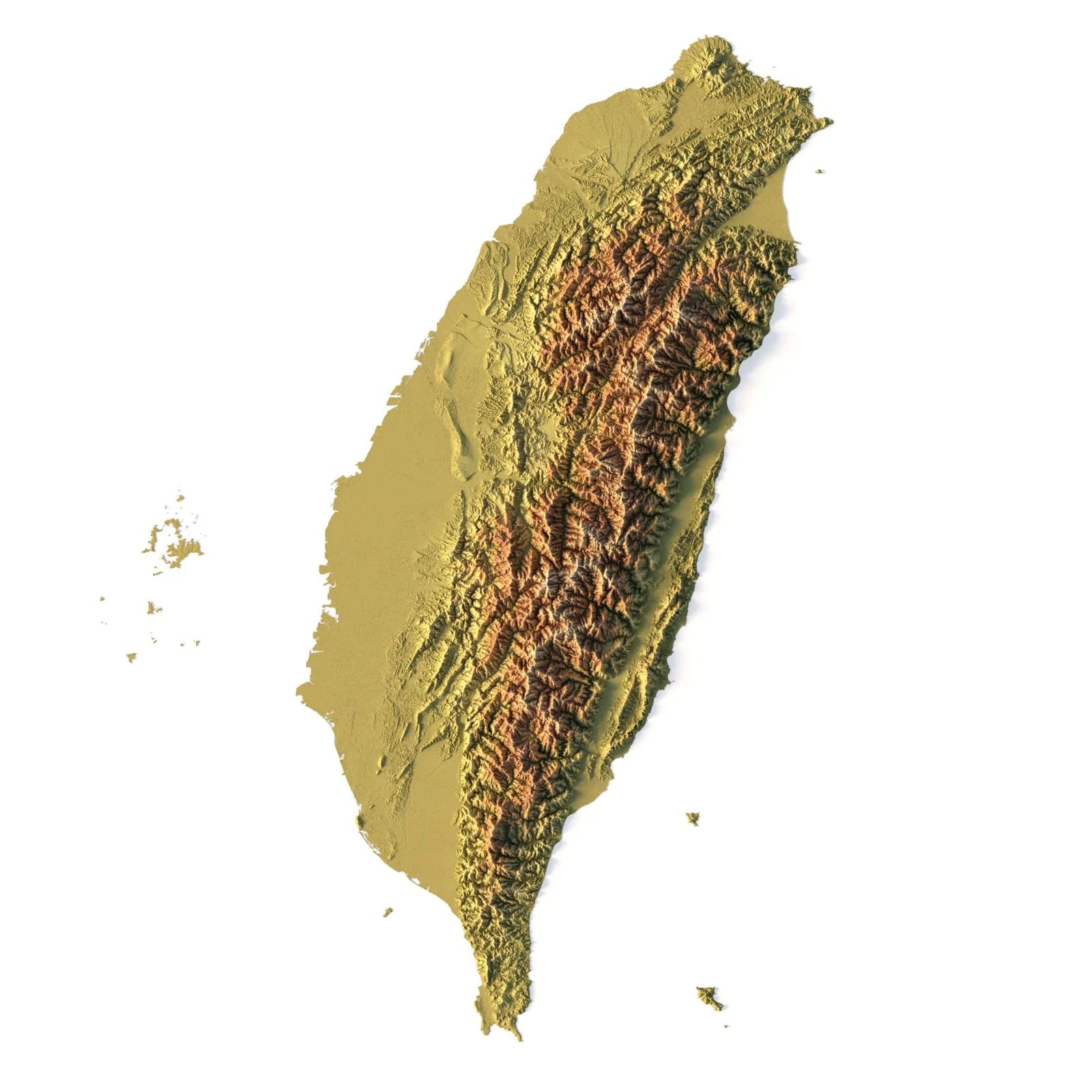
Taiwan is an island of about 36,000 km², roughly the size of the Netherlands, separated from mainland China by the Taiwan Strait. The middle and east of the country are very mountainous (Taiwan boasts 100+ peaks over 3,000 m) and its population lives mostly on the west coast and in the north. It's situated on the border of the Eurasian and Philippine Sea tectonic plates, which causes earthquake activity, mainly in the east. Despite frequent natural disasters, Taiwanese roads are kept in impeccable condition: even remote mountain roads are almost perfect without exception.
Around the main island there are a few outlying islands you can visit by ferry or plane (Penghu, Xiaoliuqiu, Orchid Island and Green Island). Just a few kilometres off the Chinese coast there are also some islands belonging to Taiwan (among others Kinmen and Matsu, not shown on the map).
History
In the late 16th century, Portuguese sailors were the first to take note of the island and called it Ilha Formosa (meaning “beautiful island”, spot on). After this, in the early 17th century, the island was briefly colonised by the Dutch, through a settlement on the shore of present-day Tainan. In 1661 Zheng Chenggong 鄭成功 (a.k.a. Koxinga), a mainland warlord, kicked out the Dutch, and the island later became part of the Chinese imperial state. Migration from and to the mainland flourished in the centuries to come.
In 1895 the Japanese took hold of the island until 1945, after which the Republicans from mainland China fled to Taiwan to escape the Communists, who took power in 1949. Ever since, China has claimed Taiwan as one of its provinces, but a completely separate democratic system now forms a de facto independent Taiwan.
As Taiwan's official stance only slowly moves from claiming back the Chinese mainland to a more pragmatic approach of keeping the current status quo, the official name “Republic of China” is still used (hence the airline is called China Airlines, for instance). For similar reasons, Taiwan is not recognised by the United Nations, the country has hardly any formal diplomatic ties with other countries, and Taiwan houses very few foreign embassies. Tensions with China have intensified over the past decade, with a progressive, independence-minded government ruling Taiwan for ten years already.
Language
In Taiwan, Mandarin Chinese (國語 guóyǔ) is the standard. Taiwanese use the traditional character script (繁體字 fántǐzì), with even more strokes to get dizzy from, as opposed to the (slightly) simplified script in mainland China. To be “fluent” in reading Chinese, you'll need to know about 4,000–5,000 characters; well-educated Chinese speakers know up to 8,000–10,000. You can also write Chinese phonetically in pinyin, which you'll see on road signs etc. It's also one of the common ways people type Chinese on keyboards. Chinese is a tonal language, meaning each syllable has one of four tones (high, rising, low, falling).
Next to Mandarin, the Taiwanese dialect (閩南話 mǐnnánhuà, or Hokkien) is widely spoken by everyone who grew up in families that have lived in Taiwan for centuries. A big minority language is Hakka (客家話 kèjiāhuà), which is one of the country's official languages as well. Lastly, in remote mountain villages, the aboriginal peoples (原住民 yuánzhùmín) have their own languages, from the Austronesian language family.
Food culture
You can't have missed the fact that Taiwan is both famous for and extremely proud of its food culture. It undeniably plays an important role in the country's cultural history, and so in every Taiwanese heart. Every region, city and village boasts its own local delicacies. It's impossible to list all suggestions, but our friend David has made a great effort on food throughout all corners of the country. See his guide: David's Taiwan food guide.